Introduction
In recent years, Ghana has seen a marked rise in defamation lawsuits cutting across politics, journalism, social media and even religious commentary. Public figures and private citizens alike are increasingly resorting to the courts to defend their reputations. This trend raises important questions: What is driving this surge? Where do we draw the line between free expression and defamation? And what role does regulation, particularly the National Media Commission, play in managing this delicate balance?
From Parliamentary corridors to TikTok comment sections, the stakes around personal reputation have never been higher. Politicians sue journalists, musicians sue influencers and ordinary citizens now send legal threats over viral tweets. The courtroom is fast becoming the frontline of Ghana’s public discourse.
While the country rightly prides itself on a strong record of press freedom, especially following the 2001 repeal of its Criminal Libel and Seditious Laws, the space this opened up has not come without tension. Digital platforms, in particular, have amplified the reach and risk of speech. A single unverified post can travel far, causing reputational harm in seconds. In this environment, defamation claims have become a key way to reclaim dignity, correct public narratives, and in some cases suppress criticism.
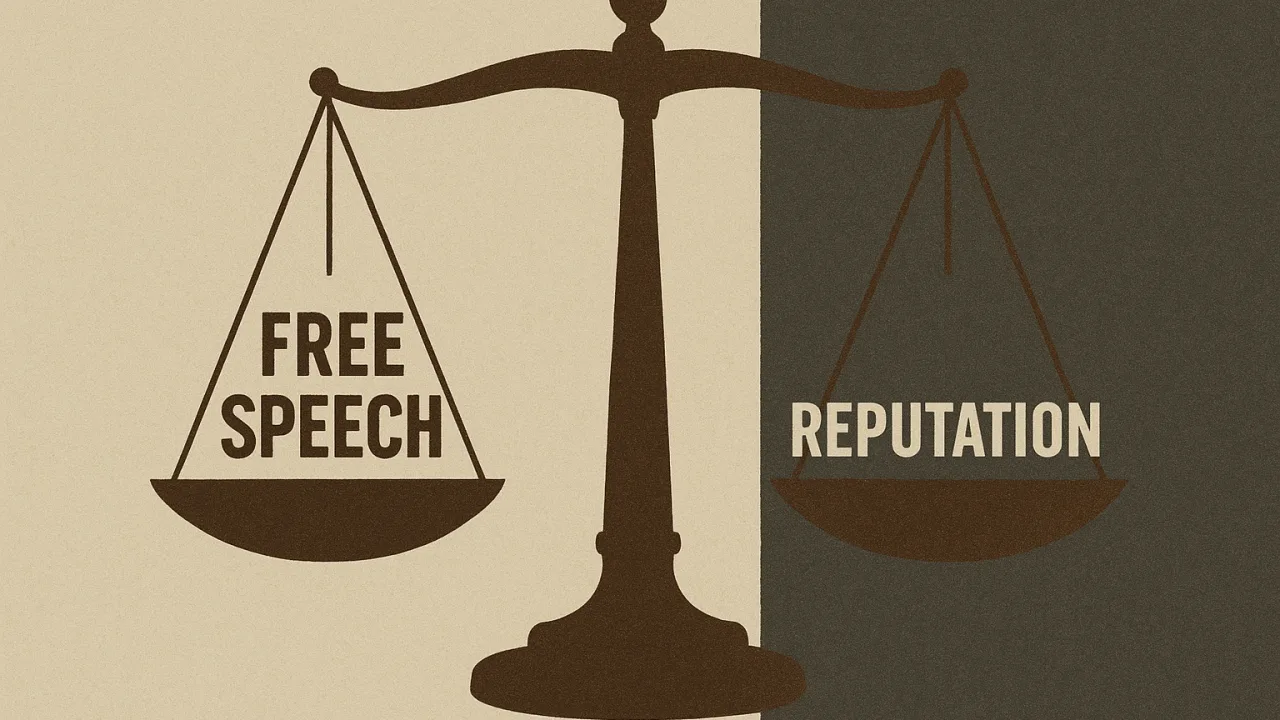
Balancing the scale
At the heart of this surge lies a fundamental constitutional tension: the right to freedom of speech and expression under Article 21(1)(a) on one hand, and the right to human dignity and reputation under Article 15(1) on the other.
While many rightly associate Article 15(1), which states, “The dignity of all persons shall be inviolable,” primarily with protections against inhumane treatment or abuse during arrest or detention, its scope is far broader. It is also the constitutional foundation for defamation law in Ghana. Defamation is defined as the publication of a false statement that injures a person’s reputation, causing them to be ridiculed, despised, or avoided by others. At its core, it is a direct violation of a person’s dignity, stripping them of the esteem and respect to which they are inherently entitled.
In the case of Anas Aremeyaw Anas v. Kennedy Ohene Agyapong, the court highlighted the delicate balance between Article 21(1)(a) (freedom of speech and expression) and Article 15(1) (right to dignity), noting that while speech is a fundamental freedom, it cannot be exercised in a way that unjustifiably destroys another’s reputation. This reinforces an important truth: Defamation is not just a tortious wrong — it is also a breach of a constitutionally protected right.
By framing reputation as part of human dignity, the Court’s reasoning elevates defamation from a private legal dispute to a matter of constitutional concern. This is where Article 15(1)’s inviolability principle becomes crucial: it protects not only the body but also the character of the individual. Moreover, Article 12(2) of the Constitution provides that all rights, including freedom of expression, are subject to the rights and freedoms of others and the public interest. This means the Constitution does not allow speech that unjustly tarnishes another’s image under the guise of liberty.
The legal and constitutional framework therefore seeks to balance two essential values: the free flow of ideas in a democratic society and the preservation of personal dignity and honour. As more people speak publicly, especially online, the law must ensure that expression is not used recklessly to destroy reputations.
National Media Commission
The National Media Commission (NMC) was established under Section 1 of the National Media Commission Act, 1993 (Act 449) to protect press freedom and promote high standards in media practice. It offers a platform for complaint resolution and media accountability, a vital non-judicial mechanism that could help reduce the burden on the courts. The Act provides for a Complaints Settlement Committee under Sections 12 to 15 to receive complaints, conduct inquiries and recommend remedies such as corrections, rejoinders or public apologies. But there is a catch: the NMC’s decisions are not binding. It cannot award damages or enforce retractions. This often renders its process unattractive to those seeking tangible remedies. Moreover, online content creators and social media influencers, many of whom are at the centre of today’s defamation disputes, often fall outside the NMC’s direct regulatory scope.
In effect, the courts remain the only place where wronged parties can get enforceable outcomes such as damages, injunctions or apologies. As a result, even media complaints that could have been resolved through mediation or peer review often escalate into full-blown litigation.
A problem to be solved
Ghana is at a crossroads. The solution is not to return to criminal defamation laws or to restrict press freedom. Instead, targeted reforms can address the current challenges while preserving democratic values. The following measures, drawn from constitutional principles and proven practices in other jurisdictions, offer a balanced approach:
- Enhance media and digital literacy so that both content creators and audiences can distinguish between factual reporting and speculation, as well as between constructive criticism and abusive commentary.
- Strengthen internal editorial controls and peer accountability within media organisations to promote accuracy, integrity, and ethical reporting.
- Expand the mandate of the National Media Commission or establish structured cooperation mechanisms, particularly for digital media, so it can provide credible and effective alternatives to litigation.
- Introduce a mandatory pre-action protocol for defamation claims, modelled on the UK’s Pre-action Protocol for Media and Communications Claims, requiring parties to attempt alternative dispute resolutions before proceeding to court.
By adopting these measures, it is possible to create a framework that delivers swift, fair and proportionate remedies without silencing legitimate criticism and, in doing so, ease the burden on the courts.
Conclusion
The current wave of defamation cases is a reflection of both an empowered public and a fragile discourse space. We must guard against the misuse of speech, but also against the weaponisation of the law. As we navigate this terrain, let us remember that freedom of expression and the right to dignity are not mutually exclusive. They must coexist, carefully and intentionally, in a constitutional democracy.
References
- IFEX. (2001, July 31). Criminal libel law repealed. IFEX. https://ifex.org/criminal-libel-law-repealed/
- Anas Aremeyaw Anas v. Kennedy Ohene Agyapong, Civil Suit No: GT/892/2018
- National Media Commission Act, 1993 (Act 449)
- National Media Commission. (n.d.). Media Centre. NMC. Retrieved 10 August, 2025, from https://www.nmc.org.gh/media-centre
- Constitution of the Republic of Ghana, 1992.
- Carruthers Law Solicitors. (2025, May). Pre-Action Protocol for Media and Communications Claims. Retrieved 15 August, 2025, from https://www.carruthers-law.co.uk/our-services/defamation/defamation-pre-action-protocol/